
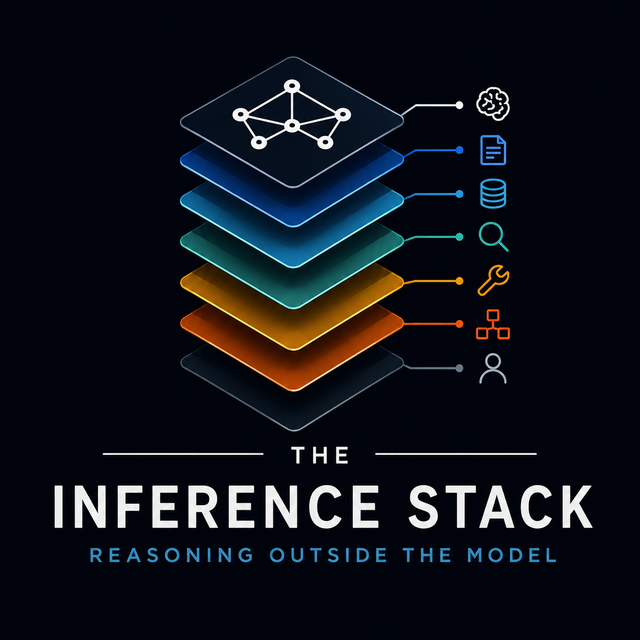
A frontier model is a probabilistic calculator over encoded patterns. It is not the system. The consequential engineering is no longer inside the weights. It is in the six layers that carry the model, and the one that answers for it.
The seven layers
- L1ModelThe weights. A probabilistic calculator over encoded patterns, bounded by its training distribution. Commoditising on a short clock, and increasingly not where advantage lives.
- L2HarnessThe engineered runtime the model executes inside: tool contracts, memory, retrieval, I/O discipline, failure handling. What makes a capability reachable and repeatable rather than occasional.
- L3AgentA bounded actor with an identity, a scope of authority, and work it is accountable for. A harness plus a standing purpose, which is a different thing from a model call.
- L4ContextWhat the agent is actually given to reason over: instructions, working set, assembled state. Finite, contested, and allocated by design. Where the token cliff bites.
- L5GovernanceThe constraints the system cannot talk its way past: gates, refusal criteria, audit, accountability. Enforced structurally rather than requested politely.
- L6OrchestrationComposition across agents and steps: routing, decomposition, verification, retry. What turns capable parts into a system that holds together.
- L7ProductWhat a person actually receives. The only layer the outside world sees, and the one that decides whether everything above it delivered value or merely worked.
Watch
The Token Cliff
Model capability commoditises on a two-year clock, so the differentiator is not which model you picked. It is the layer above it, and the lock-in that layer quietly accumulates.
The model may sometimes be rented, but the architecture must be owned.
All shortsLatest articles
Ordinal Systems Architecture: A Control Grammar for Enterprise AI Authority
Ordinal Systems Architecture (OrdSA) is a control-oriented enterprise architecture construct that orders AI capability by ordered authority, abstraction, execution rights, and evidence flow. This paper introduces the construct, its governance principle, its schema-first canonical form, related-work positioning against TOGAF, UAF, ArchiMate, NIST AI RMF, Zero Trust, IAM/PAM, policy-as-code, and DevSecOps, and a worked deployment scenario showing allow, refuse, and escalate paths through the ordinal stack.
Read ArticleThe 4M Model: A Reference Architecture for LLM Harness Engineering
A principled reference architecture organising LLM harness concerns into four modules with separated concerns and explicit coupling channels: Mission, Mind, Morals, and Memory.
Read ArticleAI Sycophancy, Dunning-Kruger, and the Discipline of Falsification
Sycophancy is not only a model-side behavior. It is an interaction pattern. The strongest guardrail is a user who wants truth more than agreement.
Read ArticleThe Token Cliff: Why the AI Vendor Era Is Already Ending
You're not buying AI. You're renting cognition by the syllable. And the meter is always running.
Read ArticleOvertake AI, or It Will Surely Overtake You
The future of knowledge work belongs to people who integrate AI into their expertise. The rest will watch from the sidelines.
Read ArticleAuthors
James (JD) Longmire, Northrop Grumman Fellow, Chief Architect for Digital Ecosystems.
- ORCID: 0009-0009-1383-7698
- Email: jdlongmire@outlook.com
- GitHub: jdlongmire
- Substack: AI Research & Philosophy
Micah Longmire, CEO and CTO of Ologos Corp; senior systems and AI architect.
- ORCID: 0009-0006-7608-9322
- GitHub: bobbyhiddn
AI assistance disclosure. This work was developed with assistance from AI language models. All substantive claims, arguments, and errors remain the authors’ responsibility. Human-Curated, AI-Enabled (HCAE).