
The Inference Stack
Reasoning Outside the Model
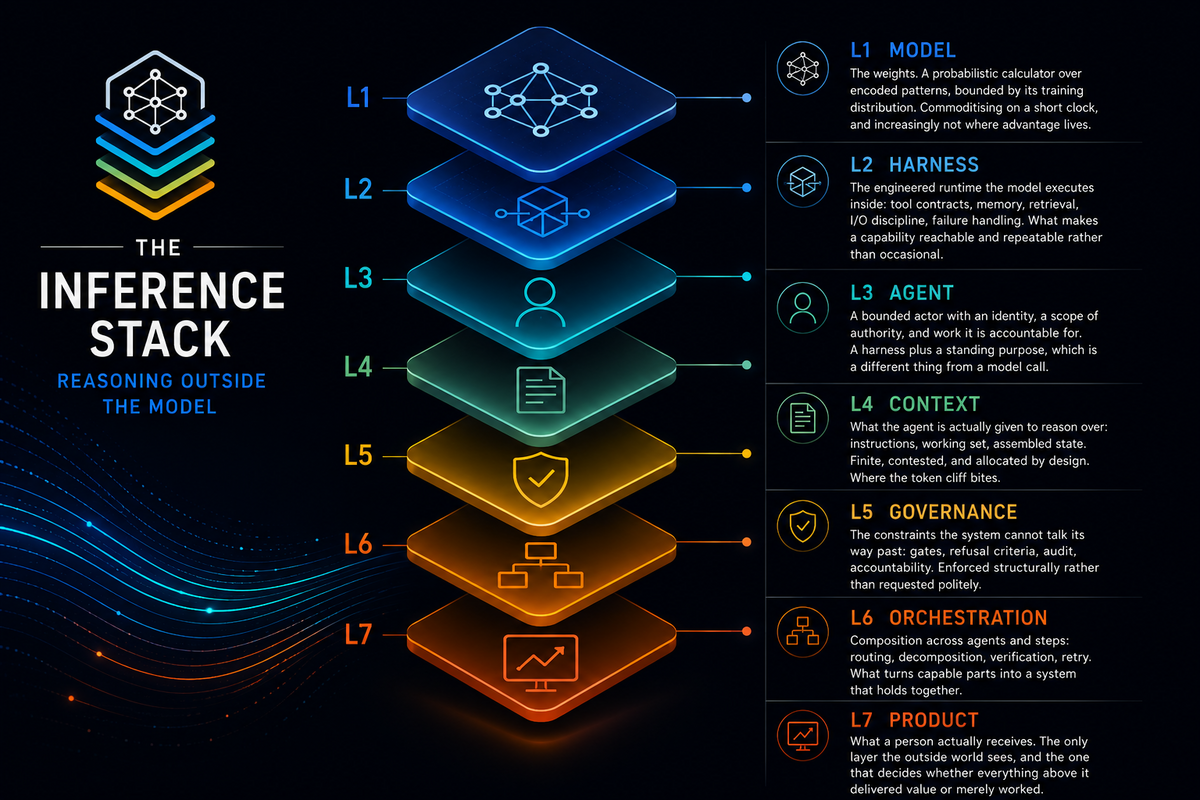
The industry talks about AI as though the model is the system. It is not. A frontier model is a probabilistic calculator over encoded patterns: extraordinary, general, and by itself inert. Everything that makes it useful, trustworthy, or dangerous is built around it.
This framework names seven layers. Six of them sit outside the weights. The claim the name makes is that those six are where the consequential engineering now happens.
Reading the stack
The model is drawn on top because that is where attention goes. It is not the foundation. Read downward and each layer is less glamorous and closer to whether the thing actually works. The bottom is the product, which is the only layer anyone outside the system ever sees, and the one that decides whether the six above it delivered value or merely ran.
- L1ModelThe weights.
- L2HarnessWhat the model runs inside.
- L3AgentWho is acting, and under what authority.
- L4ContextWhat it is given.
- L5GovernanceWhat it may not do.
- L6OrchestrationHow it is composed.
- L7ProductWhat is actually delivered.
L1 · Model
The weights, and the inference that runs them. A model encodes patterns from a training distribution and samples from them. That is a genuine and hard-won capability, and it is also a bounded one: no access to what it was not trained on, no state between calls, and no way to act.
Model capability is improving quickly and commoditising just as quickly. Two years of frontier progress moves a capability from differentiator to table stakes. Anything an organisation’s advantage rests on at this layer has a short half-life.
L2 · Harness
The engineered runtime the model executes inside: tool contracts, memory, retrieval, I/O discipline, error and failure handling, the loop that decides when to stop. The harness is what converts a capability that appears in a demo into one that survives contact with real work.
This is the least discussed layer and among the most determinative. Two teams on the same model, doing the same task, will differ mostly here. Harness quality is an engineering discipline in its own right, with its own failure modes, its own tests, and its own standards, rather than glue code around an API call.
L3 · Agent
A bounded actor with an identity, a declared scope of authority, and work it is accountable for. An agent is a harness plus a standing purpose, and that is a different object from a model call.
The distinction matters because authority is what makes an agent useful and what makes it dangerous. An agent that can act needs a scope someone drew deliberately: what it may decide alone, what it must surface first, and what it may never do regardless of how the request is phrased. Identity is not decoration here. It is what the scope attaches to.
L4 · Context
What the agent is actually given to reason over: instructions, working set, retrieved material, accumulated state. This is the layer most teams under-engineer, and it fails in ways that get misread as model failure.
Context is finite. It is also contested, since every subsystem wants room in it, and the allocation is a design decision rather than an accident. Systems that manage it explicitly degrade gracefully. Systems that do not hit a cliff, and hit it without warning.
L5 · Governance
The constraints the system cannot talk its way past: gates, refusal criteria, audit trails, and the accountability that sits behind them.
The load-bearing word is structural. A model asked nicely not to do something will eventually do it, because instructions are input and input is negotiable. Constraints that matter are enforced somewhere the model cannot reach, and the human who answers for the output stays in the loop by design rather than by good intentions. Human-Curated, AI-Enabled names that arrangement: the machine does the work, the person owns the result.
L6 · Orchestration
Composition across agents and steps: routing, decomposition, parallelism, verification, retry. Orchestration is what turns capable parts into a system that holds together.
Most of what looks like reasoning in a capable AI system is orchestration. Breaking a problem into checkable pieces, running independent checks, reconciling the results, and knowing when to stop are structural properties of how the work was composed rather than emergent properties of the weights.
L7 · Product
What a person actually receives. The only layer the outside world ever sees, and the one that settles whether the six above it produced value or merely produced output.
Putting product in the stack is deliberate. A system can be well-modelled, well-harnessed, correctly scoped, properly governed and cleanly orchestrated, and still deliver something nobody needed. The engineering above this layer is justified by this layer, not by its own sophistication.
Status
This framework is under active development. The layers are stable enough to reason with and loose enough to argue about; the articles and shorts on this site develop them.
Citation
Longmire, J.D. & Longmire, M. (2026). The Inference Stack: Reasoning Outside the Model. https://inference.thinxai.net/stack/
Human-Curated, AI-Enabled (HCAE)